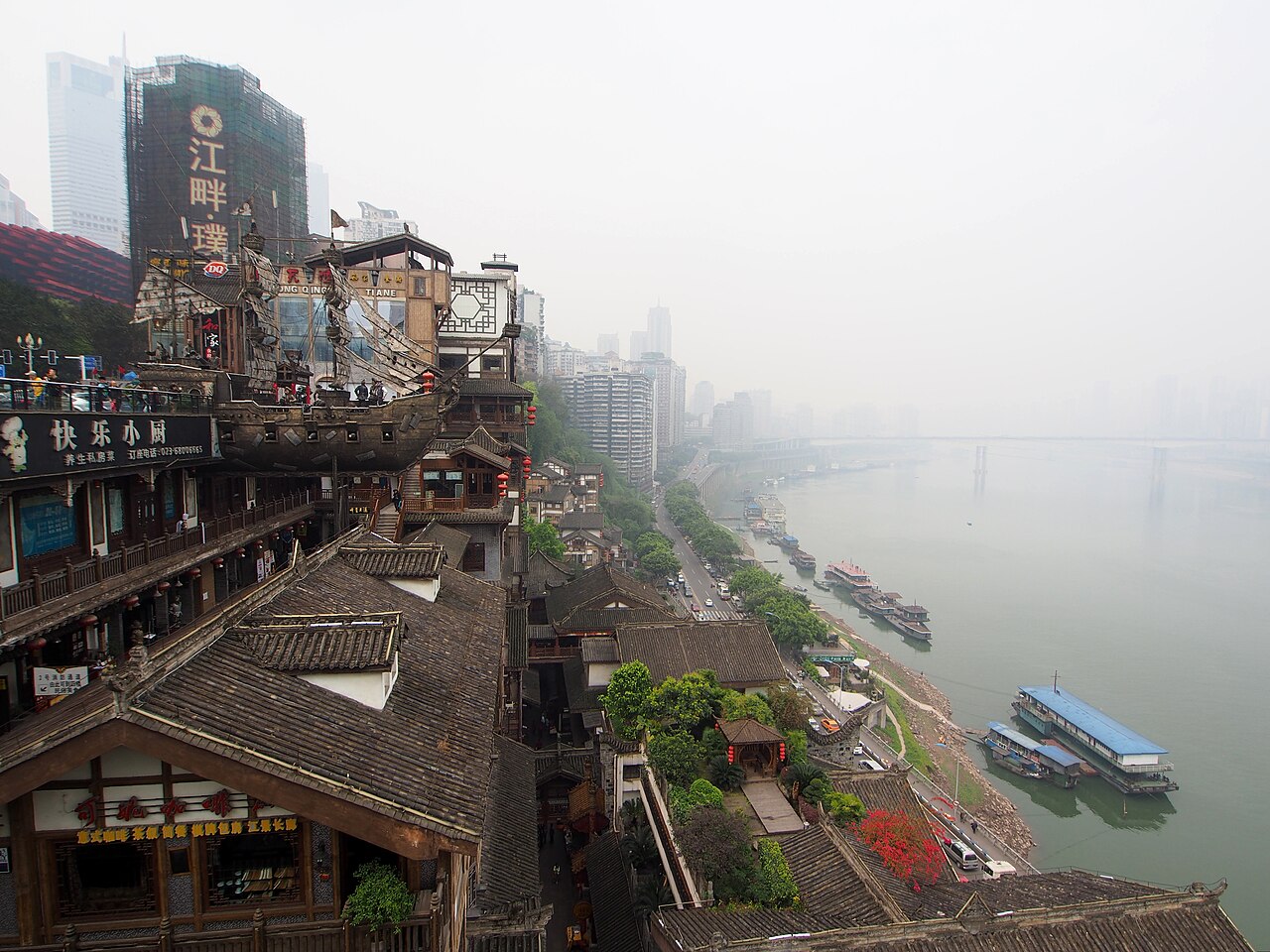
Chongqing, the city built in three dimensions
A vertical city of cliffs, cable cars and bridges on the Yangtze, best known now for hotpot and the Hongya Cave lights.
The short answer
Chongqing is a mountain city on two rivers, so give it two days and expect to move up and down rather than across. Hongya Cave and the Yangtze cableway are the set pieces; hotpot is why many people come. Metro fares are ¥2–7, though exits can open nine storeys above the street.
- Two days cover Ciqikou, Hongya Cave, Liziba and the Yangtze cableway.
- Chongqing Jiangbei (CKG) has daily domestic flights and a metro link from Line 10.
- High-speed rail: 1h 30m to Chengdu, 3h 30m to Xi'an; long legs are best flown.
- Hotpot is numbing (mala) and cooked in beef tallow — order the split pot if unsure.
- July and August top 38°C (100°F); March–May and September–November are the seasons.
China's mountain city
Chongqing spills over steep hills where the Jialing meets the Yangtze, so streets that look adjacent on a map can sit 40 m apart in height. Locals call it the 8D city: Metro Line 2 runs through an eighth-floor block at Liziba, roads stack three deep at Huangjuewan, and a cable car is ordinary public transport.
The Yangtze and the gorges
The city is the downstream end of the Three Gorges and the starting point for most Yangtze cruises. Boats leave Chaotianmen Dock for the 660 km (410 mi) run to Yichang, past the Three Gorges Dam. West of town, the Dazu Rock Carvings hold over 50,000 figures cut into the cliffs.
Hotpot, and when to come
Chongqing hotpot is a beef-tallow broth heavy with Sichuan pepper and chilli, and the numbing is the point; a meal runs ¥80–150 per person. Visit in spring or autumn, around 18–26°C (64–79°F). Summer regularly passes 38°C (100°F) and winter is grey and damp.
Hongya Cave
A stilted stack of restaurants and bars above the Jialing, lit after dark. Shoot it free from Qiansimen Bridge around 19:30.
Liziba metro station
Watch Line 2 pass through the eighth floor of a tower block. The ground-floor viewing platform is free.
Yangtze River cableway
A 1.16 km (0.7 mi) commuter crossing above the river; ¥30 single and about five minutes.
Ciqikou old town
A Ming and Qing porcelain port of steep lanes on the west bank. Weekdays before 10:00 are calm; weekends are not.
Chongqing hotpot
Order the nine-grid pot and dip in oil and garlic rather than sesame. ¥80–150 per person.
Practical
| Airport code | CKG (Jiangbei) |
|---|---|
| Direct flights from the UK | None non-stop; connect via Beijing, Shanghai or the Gulf |
| High-speed rail | 1h 30m to Chengdu; 3h 30m to Xi'an |
| Days needed | 2 nights |
| Best months | March–May and September–November |
| Visa note | UK passports: visa-free up to 30 days to 31 Dec 2026 |
| Population | 32 million (Chongqing Municipality) |
| Metro | Fares ¥2–7; exits can be far above street level |
| Yangtze cruise | Chaotianmen Dock, 660 km to Yichang |
Getting there from the UK
Chongqing Jiangbei (CKG) has daily flights across China and a growing number of international routes; Metro Line 10 reaches the centre in about 40 minutes. There is no direct UK flight, so expect a connection through Beijing, Shanghai or the Gulf.
High-speed rail from Chengdu takes 1h 30m and from Xi'an about 3h 30m, which makes Chongqing an easy addition to a Sichuan trip. Fares on the metro are ¥2–7.
How many days
Two nights, three at most. Day one for Ciqikou, the cableway and Hongya Cave after dark; day two for Liziba, the Three Gorges Museum and a hotpot dinner. Add a night only if you are boarding a Yangtze cruise at Chaotianmen.
Worth knowing if you're travelling from the UK
Chongqing is still mainly a domestic destination for British travellers, so book hotels on Chinese apps or through an agent. With no non-stop UK service, the usual route is a connection through Beijing, Shanghai or the Gulf, about 14 to 16 hours in total. English is thinner here than in Beijing, so a guide smooths the small friction.